Nintendo Switch 2 Review 2026: Is It Worth Upgrading from Switch 1?
- Sameer Verma
- May 12
- 3 min read

The original Nintendo Switch was a once-in-a-generation product — a hybrid console that changed how millions of people think about gaming. Its successor faced an almost impossible task: be worthy of that legacy without simply copying it. The Nintendo Switch 2, which launched in 2025 and continues to dominate sales charts into 2026, does not attempt to reinvent what worked. Instead, it perfects it in nearly every measurable way.
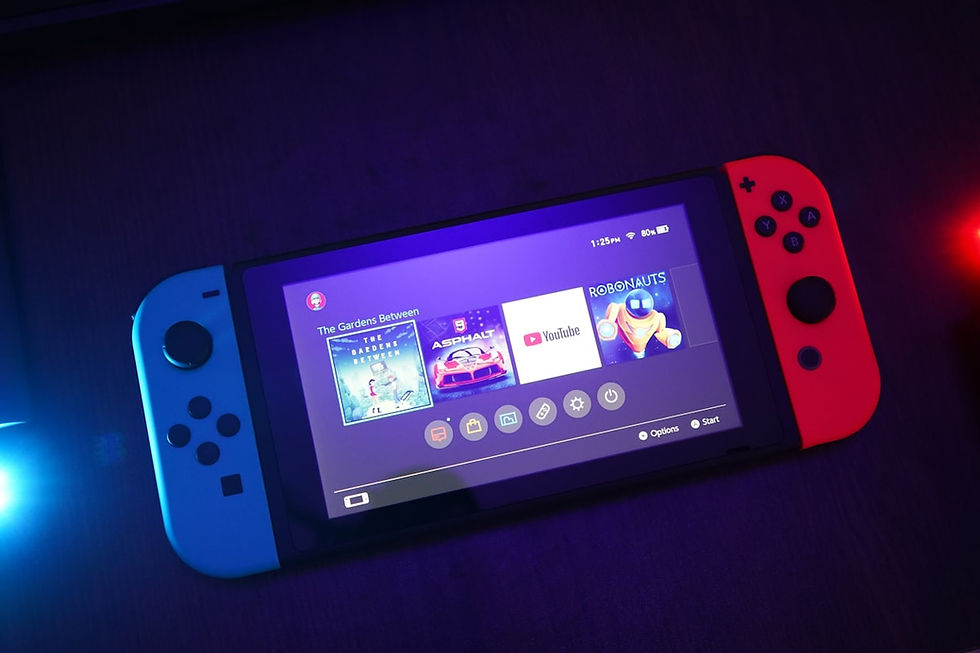
Design: Familiar but Meaningfully Better
The Switch 2 is larger than its predecessor in all the right ways. The screen has grown from 6.2 inches to 7.9 inches while retaining the same comfortable handheld form factor — achieved through significantly reduced bezels. The display is an 1080p LCD in handheld mode (outputting 4K when docked), with noticeably improved colour accuracy and brightness compared to the original Switch's panel.
The Joy-Con 2 controllers click onto the main unit magnetically rather than sliding — a change that eliminates the Joy-Con drift issue that plagued the original and results in a more satisfying, secure attachment. A new C button on each Joy-Con opens a GameChat overlay for voice and video communication with other Switch 2 users — Nintendo's long-overdue entry into modern gaming communication.
Performance: Finally in a Different League
The original Switch's Tegra X1 chip was underpowered at launch and became increasingly strained as developers pushed their ambitions. The Switch 2's custom Nvidia chip is a generational leap — supporting DLSS upscaling, ray tracing, and frame rates that simply were not possible on original Switch hardware. CNN's reviewer put 'hundreds of hours' into it, describing performance as 'significantly snappier' across the board. Third-party ports that were compromised on Switch 1 are now essentially identical to their PS5 and Xbox counterparts.
The Game Library: Still Nintendo's Biggest Advantage
Nintendo's first-party library remains unmatched in gaming. The Switch 2 launched with Mario Kart World — a new entry in the iconic franchise featuring open-world exploration between races — and has since added a growing lineup of exclusive titles. Critically, the Switch 2 is backward compatible with virtually the entire Switch 1 library, meaning the already vast collection of Switch titles (over 6,000 games) is available from day one.
Battery Life: Improved but Not Revolutionary
Battery life in handheld mode ranges from 2 to 6.5 hours depending on the game being played — a modest improvement over the original Switch. Intensive games like Mario Kart World at high settings drain the battery in around 2.5 hours, while less demanding titles extend this considerably. The included USB-C charger supports faster charging than before, getting the console from 20% to full in around 90 minutes.
Should You Buy the Nintendo Switch 2?
Buy it if: you are new to Switch, have children who would love Nintendo's family-friendly library, or play games in both handheld and TV modes
Upgrade from Switch 1 if: you play demanding third-party titles, value the bigger and better display, or want the improved Joy-Con design
Skip for now if: you only play first-party Nintendo exclusives on Switch 1 and are satisfied with the current library — the new exclusives are good but not yet unmissable
Verdict: The Best Way to Play Nintendo Games Has Just Got Better
The Nintendo Switch 2 is not a revolution — it is a masterclass in refinement. Bigger screen, better performance, improved controls, backward compatibility, and the best gaming library in the handheld space. At $449, it is $50 more than the original Switch launched at, but the hardware improvements justify the premium. For Nintendo fans and anyone looking for a unique gaming experience in 2026, the Switch 2 is an easy recommendation.
⭐ Rating: 9/10 — The perfect successor. Every meaningful weakness of the original Switch has been addressed.


Comments